


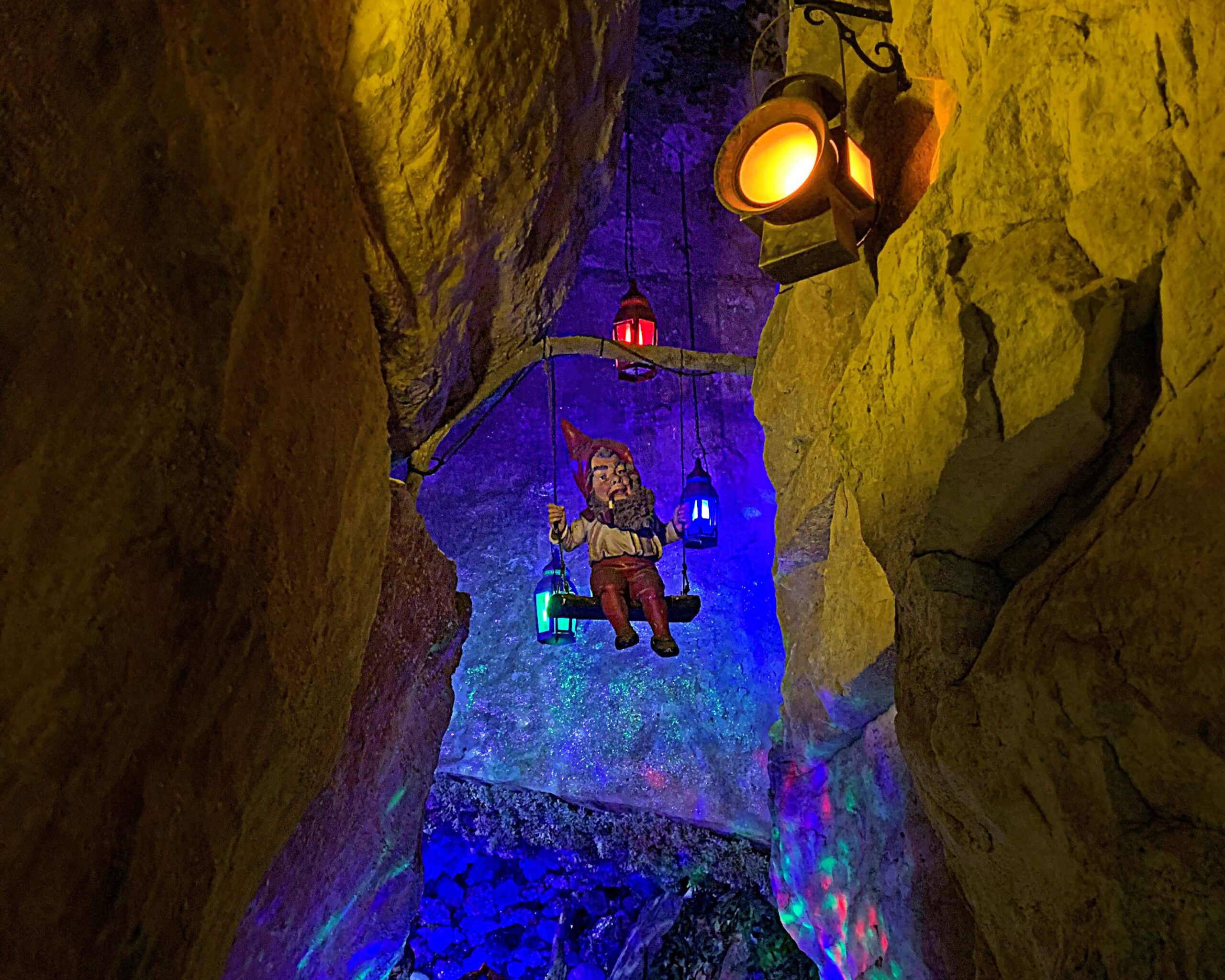
The beloved Garden Gnome is a treasured figure found in yards around the world, with origins older, and stranger than you might expect. Its story draws from religious imagery, European fairy tales, and statuary traditions dating back to ancient Rome.
Early gnome statues were fine works of art, hand-carved and painted by artisans in Germany. Freida Carter, one of Rock City’s founders, had a fondness for these characters thanks to her German heritage, and imported many original terracotta gnomes as well as other fairy tale-themed statuary.
Ancient origins
One of the earliest known examples of gnome-like garden statuary is that of Priapus, an ancient Roman god of fertility. Small sculptures of this deity were placed in gardens to ward off evil spirits in the hopes of a successful harvest.
As European folklore evolved through the centuries, tales emerged of a mythological race of short creatures believed to live beneath the earth. In fact, the word “gnome” emerged in the 16th century, likely as a derivation of the Greek genomos, meaning “earth-dweller.” The Swiss alchemist Paracelsus is generally credited with introducing the term and believed such creatures used magical powers at night to cultivate plant growth.
During the Renaissance, renewed fascination with mythological and fantastical figures helped embed such creatures within Europe’s cultural imagination. At the same time, Northern European artists produced decorative “grotesques”—fantastical, often hunchbacked figures used in architecture and ornamentation—which reflected the era’s fascination with whimsical and mythical beings.
Modern gnome takes shape
The modern image of the garden gnome began to take shape in the 18th and especially the 19th century, when masterfully sculpted lawn ornaments and house ornaments became luxury items across Europe. It’s no surprise that Germany, home to a rich tradition of folklore and fairy tales, emerged as a leader in garden gnome manufacturing.
Philipp Griebel was one of the most prolific garden gnome makers of the late 1800s. He hailed from the Thuringian village of Gräfenroda, an area known for its clay deposits and long tradition of ceramics. It was here that he is believed to have created the contemporary image of a red hat gnome that we know today.
The early 20th century marked highs and lows for the garden gnome. They attained pop culture fame in Walt Disney Production’s 1937 film, “Snow White and the Seven Dwarfs,” introducing new audiences to earth-dweller folklore. However, World War I and World War II all but devastated Europe’s gnome-making industry.
Griebel’s company, Zwergstatt Gräfenroda, managed to survive the wars, but production was once again dampened as his village, Gräfenroda, became part of East Germany where trade and distribution were tightly restricted. Nonetheless, Griebel’s company persisted and remains the lone surviving garden gnome manufacturer in Thuringia.
The majority of Europe’s handcrafted gnome manufacturers couldn’t compete with the rise of Asia’s mass-produced garden gnomes. Thus, artisan-made garden gnomes are a rarity today.
However, artisan-made garden gnomes aren’t a rarity at Rock City, where you can find a number of Zwergstatt Gräfenroda gnomes in Fairyland Caverns today. In fact, many of Rock City’s original gnomes date before the gardens even opened, with some already considered antiques by the time they reached Lookout Mountain nearly 100 years ago.
Rock City gnomes

The story begins in 1924 when serial entrepreneur Garnet Carter and his wife Freida purchased land atop Lookout Mountain to develop into an idyllic resort-style neighborhood, calling it “Fairyland.” Thanks to Freida’s love of Fairytales, they went all in on the theme, naming the streets after characters like Cinderella, Aladdin and Mother Goose. The final touch was to ornament the community with fairytale-inspired sculptures like German-imported gnomes.
However, the gnomes didn’t have much time to settle into the neighborhood, as Garnet required their services. The Fairyland Golf Course was running behind schedule, and visitors and residents alike were growing impatient. Garnet needed to buy some time, so he went ahead and created a miniature golf course—the world’s first. He called it Tom Thumb Golf, decorating each hole with amusing challenges. And, of course, it featured fairytale creatures like gnomes.
Meanwhile, Frieda was working on a venture of her own—a backyard garden. Her cliffside plot of land, replete with towering rock formations, was already a popular natural wonder prior to the Carters ownership. The Carters began working in 1930 to make their informal rock garden more accessible and inviting to the public. She wove yarn up and over and through the rocky landscape to create paths for what would become a garden like no other filled with geological and botanical wonders. It wasn’t long before Garnet saw the commercial potential that Frieda’s garden had. So, he once again moved his Fairyland statuary, this time to Rock City.
The gnomes were originally placed along the trail, with one scene depicting an orchestra of gnomes atop a rock. But the gnomes were moved one last time in 1947 when Fairyland Caverns opened to visitors.
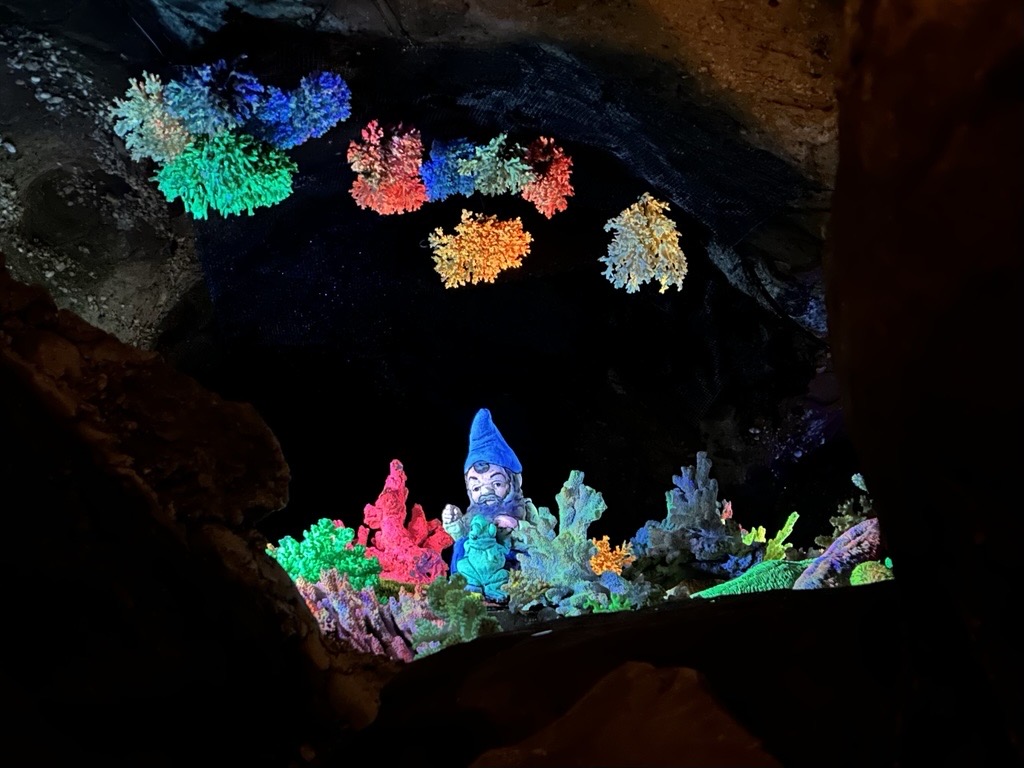
This underground world of fairytale scenes, illuminated by then-revolutionary immersive blacklight technology, brought the Rock City experience to a new level. Though blindness had prevented Frieda from seeing the completion of the caverns, she is said to have been satisfied with the results, running her hands along the statues and letting her mind paint the scenes.
The original Zwergstatt Gräfenroda gnomes were joined by a host of new characters, as husband-and-wife artists Charles and Jessie Sanders carefully sculpted each scene. Among Jessie’s most fascinating creations is the Carnival of the Gnomes on a Ferris wheel, just after Mother Goose Village.
Jessie made each fairytale figure on-site. First, she created molds from full-sized clay models. Then reproduced figures were cast using a gypsum cement material known as Hydrocoal. Her final touch—a coat of fluorescent paints—gave the characters their signature glow.
Yes, we still make gnomes
Like any piece of handcrafted art, our Gnomes have a lifespan. After 90 years of scorching Southern heat and the ever-damp conditions of Fairyland Caverns, it’s no surprise when cracks begin to show.
Will Jackson, Rock City’s Creative Director, looks after the gnomes’ well-being. He and his team lovingly repair the fragile and worn antique figures. Repairs must be done carefully; since many of the original molds have degraded over time, maintaining the gnome’s quality can be difficult. What’s more, age, elements, and even vandalism have left their mark.
So, Rock City has turned to 3-D printing to recreate modern versions, using advanced scanning technology to capture each figure in extraordinary detail and preserve it as a digital model, ensuring that even the oldest gnome can be faithfully recreated.
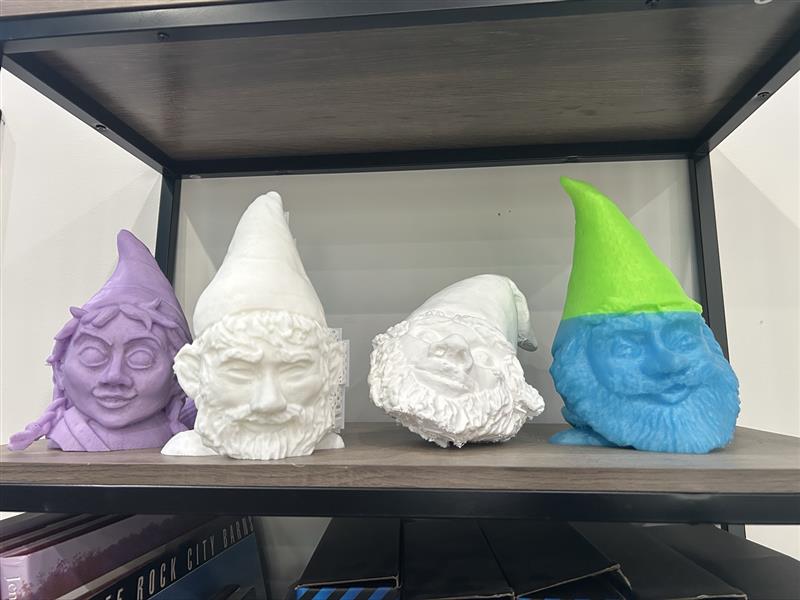
These gnomes carry on the tradition of being crafted in-house, just as Jessie Sanders’ original figures were. First, being hand carved using the subtractive method, then scanning, and 3D printing, followed by being hand painted. The 3-D models are made from a sugarcane-based plastic, offering greater durability in humid conditions while remaining environmentally friendly.
Though often dismissed as kitsch, garden gnomes share a rich history rooted in European folklore, craftsmanship, and artistic tradition. The original handcrafted gnomes imported by Frieda Carter remain among our most treasured wonders, and we’re proud to keep the craft alive in our own unique way. By blending time-honored techniques with modern printing, we ensure these whimsical guardians of Rock City will live within our stone walls for years to come.