


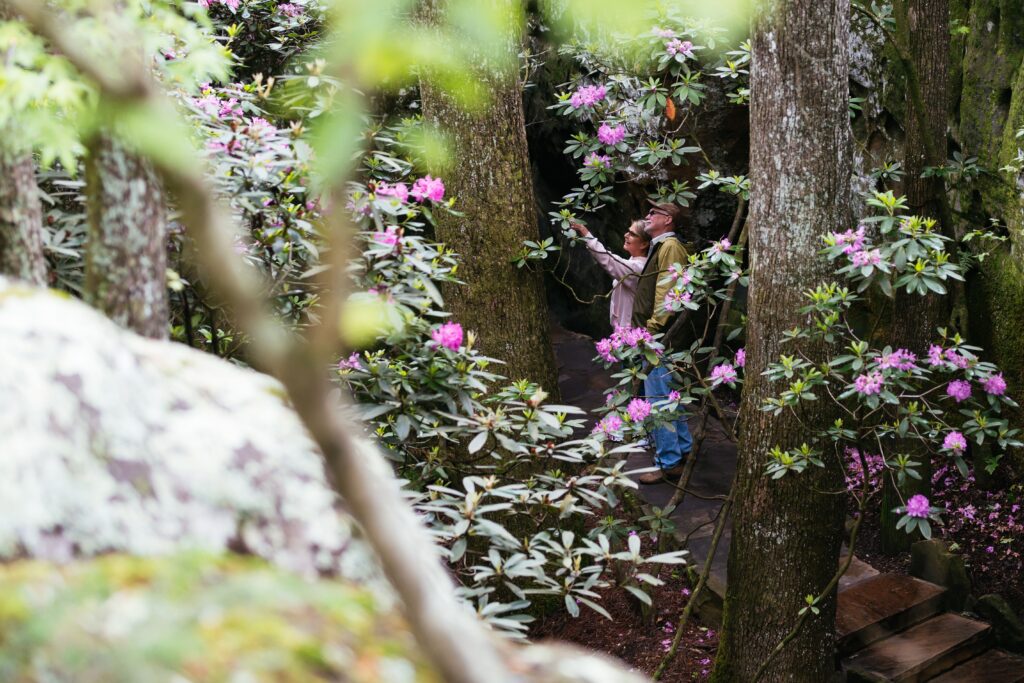
For all of Rock City’s incredible features—towering rock formations, sweeping views and fairytale charm—the gardens themselves are perhaps its most humble treasure.
Located in the heart of the Southern Appalachian Mountains, one of the most biologically diverse regions on Earth, Rock City boasts over 500 species of native plants across its 14 acres. What began as an ambitious backyard project has thrived for over 90 years as a living and constantly evolving native garden.
Rock City’s garden legacy traces back to its co-founder, Frieda Carter. In the late 1920s, she began transforming her cliffside property, home to some of the most unusual rock formations on Lookout Mountain, into a whimsical garden. Her original plantings were of native varieties she relocated from around the mountain.
As word spread about Frieda’s remarkable garden, outside interest grew. Her husband, Garnet, a natural promoter, was more than happy to cater to the crowds and invested in her vision. Thus, in 1932, Rock City Gardens opened to the public to immediate acclaim. Her conservation work earned her the Garden Club of America’s Horticultural Bronze Medal of Distinction the following year.
Nine decades later, Gardens Manager Lori Martinez continues to build on Frieda’s vision, stewarding a thriving ecosystem where native species of plants and animals flourish together.
Since joining Rock City nine years ago, Martinez’s goal has been to keep Frieda’s native plant legacy alive.
Lookout Mountain is a flat-topped formation composed primarily of sedimentary rock such as shale and sandstone, with underlying layers of porous limestone. Its geology plays a key role in shaping the mountain’s soil composition. Martinez notes that the soil at Rock City is darker and richer than in the valley. Revealing Rock City’s hidden botanical beauty is an art in itself, requiring a delicate balance between intentional planning and allowing the trail to shape the garden naturally.
“Our plan is to react with the way the terrain allows us to react,” Martinez said.
Unlike traditional gardens built on flat or sloped land, the gardens of Rock City take root atop boulders and within the shady valleys of rock chasms. Climate and sunshine is also a factor.
In addition, a dense canopy of hemlocks, pines, maples, and oaks provides abundant shade, creating ideal conditions for plants like azaleas and rhododendrons.
“Lookout Mountain is cooler than the valley, so it supports a distinct ecosystem,” Martinez said.
Take, for instance, the Grand Corridor—an elongated valley framed by towering rock walls and one of the most botanically rich sections of the trail. You’ll find lush ferns and moist boulders covered in moss and lichen, displaying a microecosystem of green textures.
Other parts of the trail are sunnier and feature deeper soil, making them ideal for pollinator gardens.
“Pollinator gardens are designed to bring in a lot of our insects like butterflies,” Martinez said. “Pollinators are extremely important. If we didn’t have pollinators, the world’s food sources as we know it would cease to exist.”
Pollinators are anything that helps move pollen from one part of a flower to another, helping initiate fertilization. Though some plants can pollinate themselves, others rely on wind, water or various insects and animals to carry out the process—including birds, which serve as passive pollinators.
Martinez’s goal is maintaining 95% of the gardens, to be made up of native plants, like Milkweed, Hollies, Beebalms, Coreopsis, Goldenrod, Pennsylvania Sedge, Rhododendron, Oak Leaf Hydrangea, and Mountain Mint.
So far, it’s been working, and is helping fuel the biodiversity that supports wildlife, providing food sources for birds—from robins and bluebirds to chickadees, nuthatches and even pileated woodpeckers.
“A lot of natives are overlooked because they are what most people consider weeds,” Martinez said. “We tend to mow down stuff because we don’t know what it is. There’s a great population of native species that are right under our feet, and we never even know it because we’re so used to the green lawns of our subdivisions. That’s something we’re trying to help people discover here at Rock City.”
Rock City’s efforts were recently recognized with certification as a pollinator habitat by Monarchs Across Georgia, a committee of the Environmental Education Alliance dedicated to restoring butterfly habitats across the state.
In her memory, Rock City remains committed to our founder’s vision of stewarding the gardens with consideration and care. From intentionally planting pollinator gardens to protecting our cherished hemlocks, the work of our Gardens Team centers on nurturing the natural biodiversity of Rock City and in turn helps sustain Lookout Mountain’s unique ecosystem.