


Advertising is flashy and fickle: one day you’re remembered, the next you’re forgotten. Staying top of mind is the goal—but it’s hard work that requires out-of-the-box ideas.
For decades, Rock City’s unconventional advertising, like barns and birdhouses, have created brand recognition like no other.
In the mid-1930s advertising was still rudimentary—newspaper ads, wall murals, hand-painted signs, radio ads and posters. But a new medium was on the horizon: roadside advertising. Business owners like Rock City cofounder Garnet Carter jumped at the chance to reach the growing number of families taking to the highways.
However, this was a time before billboards were the standard—signs were typically hand-painted and came in all shapes and sizes. In rural areas, the sides and tops of barns and other outbuildings became an advertiser’s canvas.
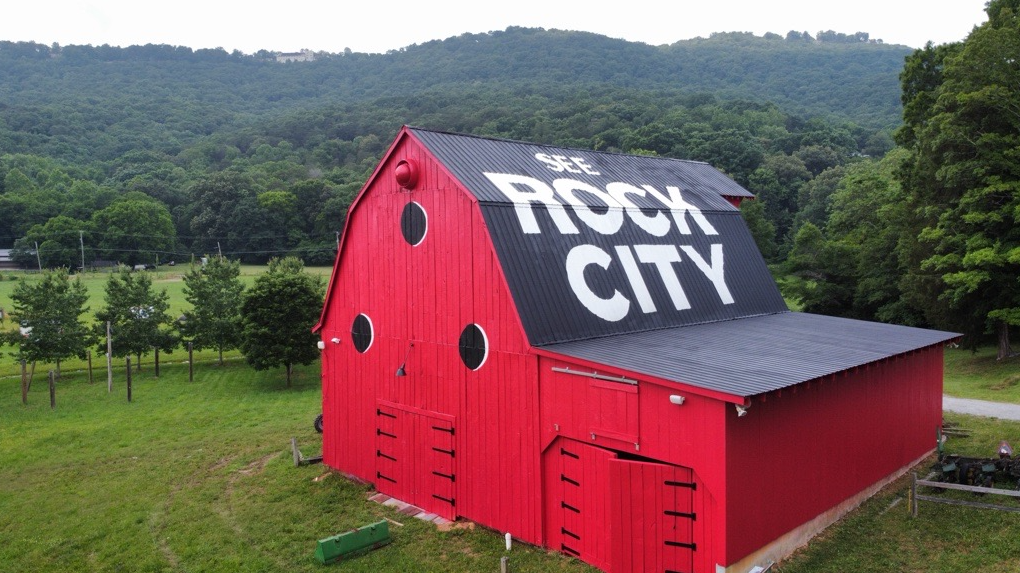
Garnet hired a young sign painter named Clark Byers to paint “SEE ROCK CITY” and similar messages atop barns along highways. Since this was during the Great Depression, many farmers and property owners welcomed having their barn painted for free. Byers Completed his first barn in 1936 near Kimball, Tennessee, and would go on to paint barns across the Southeast. His work was so prolific, he painted barns as far away as Michigan and Texas and far south as Florida. Slogans like “SEE 7 STATES from ROCK CITY ATOP LOOKOUT MT.” and “SEE BEAUTIFUL ROCK CITY WORLD’S 8TH WONDER” in bold block letters on black roofs appeared on barns with red walls. However, the most common, and most impactful slogan was the simple phrase we became known for: “SEE ROCK CITY.”
Three simple words were all it took. In short, it conveys that you just have to see it to believe it.
Rock City isn’t easily summed up: it’s a cliffside garden bursting with wildflowers, towering rock formations, winding woodland trails dotted with gnomes and fairytale figures, and, of course, that famous seven-state view.
“SEE ROCK CITY” was simple, repetitive and memorable; it conveyed a sense of intrigue. The more signs you saw, the more questions you had—and the more you wanted to see Rock City for yourself.
The 1950s became Rock City’s advertising golden age, as brand recognition reached its peak thanks to the barns. To this day, the Rock City barn is perhaps the most memorable example of barn advertising. Its legacy is celebrated at the American Sign Museum in Cincinnati, Ohio, where an entire side of a Rock City barn is displayed.
Earning a place in advertising history probably wasn’t Garnet’s intention—he was just looking for something a bit more effective than his previous marketing efforts.
In the beginning, Rock City had been selling “colorized” postcards, which were just black-and-white photographs that were painted to bring the pictures to life. But they quite literally didn’t paint Rock City accurately and, most importantly, had a limited advertising reach.
Garnet also devised a peculiar road advertisement of sorts: a painted yellow line. Back before road markings were common practice, Rock City thought it clever to paint a yellow line up Ochs Highway, from the bottom of Lookout Mountain all the way to Rock City, as motorists “follow the yellow line to Rock City.” This was helpful in theory, but its reach, too, was limited, as it only appealed to drivers who were already on their way to the gardens.
The barn advertisements, meanwhile, could be anywhere. All that was needed was a barn and Clark Byers’ painting prowess.
As an homage to his craft, Byers crafted himself a Rock City barn-inspired mailbox. The U.S. Postal Service, however, denied its use because it wasn’t an approved design. So, Byers, a creative thinker, poked holes in the front of his handmade mailbox and called it a birdhouse.
The barn-inspired, mailbox-turned-birdhouse inspired bigger versions, which Byers raised on tall poles along highways as a bold new kind of advertising. Those large birdhouses, or “birdhouse condos,” sparked the creation of the Rock City birdhouses that remain popular to this day.
The birdhouse is the most famous Rock City souvenir, but there were others. In 1951, Dick Borden spearheaded Rock City’s new advertising department, the National Service Agency, with plans to insert “SEE ROCK CITY” into every nook and cranny along American highways. Borden made deals with motels, restaurants and businesses across the Southeast—wherever prospective tourists congregated—to furnish their establishments with Rock City-themed merchandise. Motels received soaps, dish towels, ashtrays, doormats, and framed pictures. Restaurants were given wall clocks and branded guest checks, while service stations received maps. It was a win-win—businesses appreciated the décor and free useful merchandise, and Rock City enjoyed the exposure (And they wouldn’t mind if guests took home a few Rock City designated souvenirs).
One of the most beloved advertisings was the Rock City birdhouse mileage meter, a fixture of many restaurants, including Lupi’s Pizza Pies in downtown Chattanooga. This metal box birdhouse featured a wheel with cities and their distance to Rock City. Patrons—especially children—would enjoy spinning the wheel in search of their hometown while waiting in line.
By the 1960s, however, the advertising golden age began to lose its glimmer, beginning with the barns. The future seemed uncertain for many roadside attractions as the new Interstate Highway System practically bypassed many of them. Adding to their worries was the looming threat of losing their roadside advertisements—rustic, handmade signs now deemed unsightly by the federal government.
With the passage of the Highway Beautification Act of 1965—better known as the ‘Lady Bird Bill’ after First Lady Lady Bird Johnson—Rock City’s famous barn-painting efforts ended abruptly, leaving the barns as relics of a bygone era.
Under the new law, any Rock City barn outside of designated commercial zones had to be painted over, immediately dwindling the number of barns. Very seldom were new barns painted, but retouches have been made over the years to some of Rock City’s most cherished barns.
This didn’t deter Rock City, however, never shying away from new ideas no matter how kooky it sounded. Even before the barn era ended, Borden was always dreaming up clever creations. The 1950s saw the debut of the mobile Rock City barn—a barn-shaped trailer designed to steal glances on the road and at events. The mobile barn was replaced and updated through the years and made appearances in local parades. A similar concept was implemented in the 1970s for the Rock City Revue puppet show, featuring an oversized birdhouse that entertained children at shopping centers.
The 1970s also saw Rock City debut branded hot air balloons. Pilot Randy Rogers and skydiver Bill Bolton would wow crowds across the country with their aerial spectacle. Rock City even took tourists high above Lover’s Leap in the balloons, but the promotion was short lived and nothing more than a memory.
Trends come and go. Promotions do too—like Rock City ashtrays, dish towels and even hot air balloons. Even with Rock City’s visual rebrand, the barns and birdhouses remain as testaments to our past and symbols of our creative spirit.
On that note, perhaps it’s best to let the barns themselves have the last word: ‘Millions Have Seen Rock City. Have You?’