


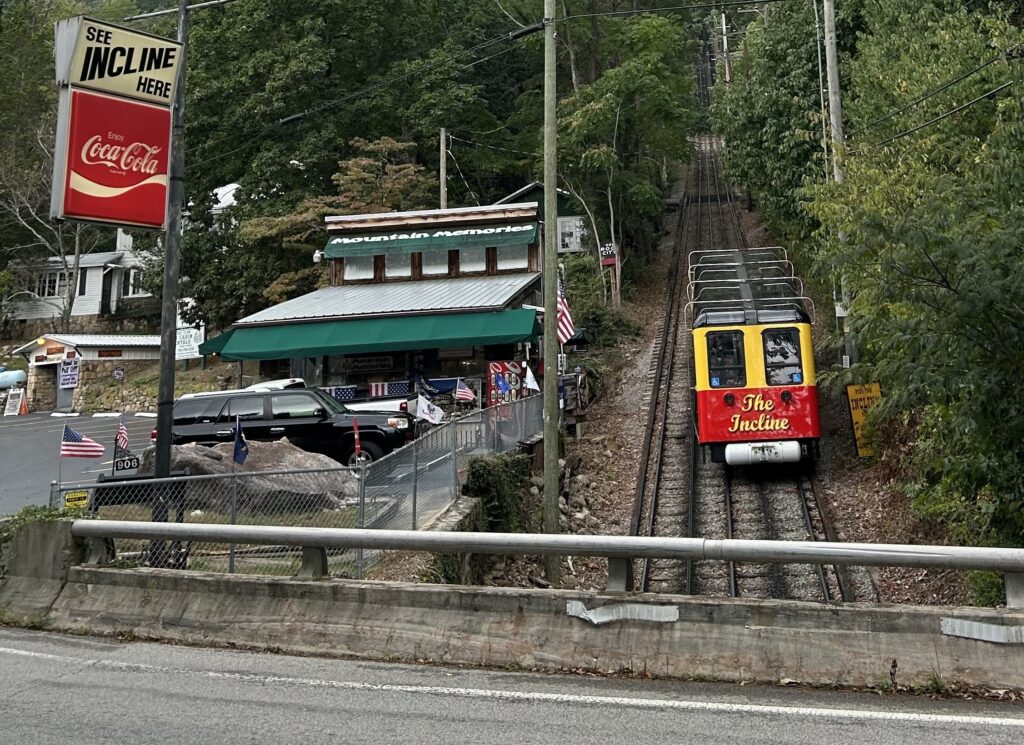
Long before Rock City was built in 1932, Lookout Mountain, Georgia captivated the minds of many, with tourists, developers, and even Civil War armies setting out to conquer its slopes. Even prior to the Civil War more than 75,000 tourists a year were visiting the top of ‘Lookout’ to take in the natural beauty and views of Moccasin Bend. At that time Whiteside Turnpike, built over an ancient Native American path, was the only public road accessible. It took travelers to one of the mountain’s earliest tourist developments, the Lookout Mountain Hotel, built in 1857 (destroyed by fire a few years after the Civil War).
Tourism declined during the Civil War and was not to be revived until the late 1880s, when the mountain saw renewed interest. However, these eager developers faced an uphill battle, both physically and legally.
The Whiteside family enjoyed a mountaintop monopoly, owning both the overpriced turnpike and its destination—the ‘point,’ a popular tourist spot now known as Point Park. When a free road to the “point” was opened and began siphoning travelers from the Whiteside’s toll road, the family responded by making the “point” only accessible to travelers who chose their road, plus an additional fee to access the park. A liveryman who operated on the free road brought forth a lawsuit against the Whiteside family, but there was no arguing about private property rights. So, local business owners cleverly bought the land directly below the “point” to build a hotel. After all, it’s virtually the same view.
This time, the developers wanted to scale the mountain on their terms. In 1887, the isolated mountaintop, rising roughly 1,400 feet above the city—which once took hours to summit—was made accessible in just minutes with the construction of a three-foot narrow gauge funicular railway.
A funicular railway, also known as a cliff railway, is used to climb steep terrain—much steeper than conventional trains can safely and feasibly handle. An incline railway is technically a giant counterbalance, with two railcars placed at opposite ends of a cable: As one car ascends from the bottom station, the car at the top station simultaneously begins its descent. As the cable controls the car’s movement, wheels guide the cars along the track.
“Incline Number 1”, built by the Lookout Point Incline Company, started at the base of the mountain in St. Elmo, climbing to the Point Hotel where it connected to a narrow gauge railroad that ran along the west brow to Sunset Rock. Featuring 23-seat open-air cars, the railroad scaled the mountain at a maximum grade of 33%.
Before the project was completed, work was already underway on a second railroad up the mountain, built by the Chattanooga and Lookout Mountain Railway Company. Known as the “Broad Gauge”, this railway, which opened in 1888, began its 15-mile, over one-hour journey in downtown Chattanooga and snaked its way up the mountain.
In 1890, the 365-room Lookout Mountain Hotel was built to accommodate the railroad’s passengers, though it would be destroyed by fire in 1908.
Though successful, the Broad Gauge was plagued with internal problems, which caused it to lose money each year. Seeking a better alternative to the fledgling railroad, another group of investors got together to build the best incline the mountain had to offer. The Lookout Mountain Incline Railway Company sought to build an incline straight up the mountain—no switchbacks or regard for terrain; just a direct line from base to summit.
Still in use today, the ambitious “Incline Number 2” proved to be fast, safe and reliable—exactly what Lookout Mountain needed. First carrying passengers in 1895, the ‘Incline’ as we know it today is one of the world’s steepest passenger railways, boasting a 72.7% grade near the mountain’s crest. Its success was immediately apparent and sounded the death knell for its competitors: Incline No. 1 ceased operations in 1899, followed by the Broad Gauge in 1900.
The Incline’s first iteration was powered by coal-burning steam engines and built almost entirely with locally sourced parts, except for the cables, which were manufactured by the same company that supplied cables for the Brooklyn Bridge. What’s more, Rock City’s original Swing-A-Long Bridge was built using leftover cable from the railway’s construction. In 1911, The Incline switched to electric power, utilizing two 100 horsepower engines to move the cable.
The Incline became more of an attraction than a public service in the 1920s and 1930s, as paved roads tamed the mountainside. By this time, tourists began flocking to Lookout Mountain’s then-newest landmarks, Rock City and Ruby Falls. But modernization efforts over the years have kept The Incline with the times. The Victorian-era railroad has long been a magnet for tourists and adventure-seekers. Even President Teddy Roosevelt had to experience “America’s most amazing mile” in 1905 during his time in office, as did Elizabeth Taylor in the 1950s.
Today, The Incline remains a celebrated feature of Lookout Mountain and one of Chattanooga’s top attractions. The railway marvel was designated as a National Historic Site by the United States of the Interior in 1974 and was named the 100th National Historic Mechanical Engineering Landmark by The American Society of Mechanical Engineers in 1991.
Remarkably, in its storied history The Incline has not once suffered a passenger fatality, though calamity has struck. Three separate fire incidents have rendered the railway inoperable for short periods of time, most recently in 2024, when a rockslide sparked a wildfire that spread to the tracks, severing the cable.
Catastrophic fires in 1896 and 1919 coincidentally broke out at the top station. In each instance, flames spread to the track, igniting the cars and melting the cable, causing the cars to plummet down the mountain and derail in a fiery spectacle.
State-of-the-art railcars were introduced in 1920. The wooden cars were upgraded to steel in 1949, with additional replacements in 1987 and 2020. The 10 mph ride itself, however, is relatively just as it was in 1895.
The current Incline railcars seats 42 riders in an enclosed setting, with wide windows on the sides as well as the roof – for horizontal viewing at the journey’s steepest segment. What’s more, the railcars are designed to accommodate manual and electric wheelchairs.
Tickets to ride The Incline can be purchased at both the bottom and top stations — $22 roundtrip for adults; $10 for children. Riders typically park at the bottom station in St. Elmo, where parking is abundant, and take the 10-minute ride up the mountain. The top station features a multi-story outdoor observation deck, a gift shop and a dining area. Point Park, part of the Chickamauga and Chattanooga National Military Park, is a short stroll from the station, as is the Battles for Chattanooga exhibit, which features a digital projection-mapped show of area’s Civil War battles. On the return trip to St. Elmo, enjoy a scoop of Clumpies Ice Cream at the bottom station.
Since 2004, Rock City has managed ticketing and concessions at The Incline. This partnership reflects the attractions’ intertwining history and helps serve the shared mission of drawing thousands of visitors to Lookout Mountain each year. It should be noted that The Incline does not connect to Rock City or Ruby Falls. Both attractions, however, are just a short drive from either station. Can’t decide which to visit? It is worth seeing all three!